Outcome of a Multiple Injured Blood Group O Rhesus-Negative Pregnant Woman: A Rare Case Report
* Mohammed Bukari;
Asumah H;
* Adam M;
* Suoseg D;
-
* Mohammed Bukari: Department of Surgery, School of Medicine and Health Sciences, University for Development Studies, Tamale, Ghana.
-
Asumah H: Department of Trauma/Orthopaedic Surgery, Tamale Teaching Hospital, Tamale, Ghana
-
* Adam M: Department of Obstetrics and Gynaecology, Tamale Teaching Hospital, Tamale, Ghana.
-
* Suoseg D: Department of Obstetrics and Gynaecology, Tamale Teaching Hospital, Tamale, Ghana.
Abstract
The management of multiple fractures resulting from trauma in pregnancy presents a unique balancing act for the surgeon. The severe physiologic derangement posed by trauma, its effect on the fetus, and complications to the mother require tactful maneuvering, more so in a negative woman married to a blood group AB Rhesus-positive man.
We report a case of a 26-year-old Gravida two para one alive (G2PIA) who presented to the Tamale Teaching Hospital with multiple fractures(open Gustilo Anderson IIIA mid-shaft fracture on the left femur with an ipsilateral open Gustilo Anderson IIIA fracture of the Tibia and fibula, and a closed mid-shaft femur fracture of the right femur), blood group O Rh-negative with an HB of 6.0 on admission.
This case study emphasizes the possibility of a favorable outcome for both mother and child, with multiple injuries and a preexisting risk of Rhesus incompatibility. The narrative focuses on when to operate, the type and duration of anesthesia, the duration of surgery, the management of blood loss, and post-operative pain management.
A well-coordinated multidisciplinary approach is required to ensure a favorable outcome for mother and child in a low-income socioeconomic setting with such high-risk cases.
Introduction
Trauma during pregnancy is the leading cause of non-obstetric maternal mortality [1,2]. About 20% of maternal deaths are directly attributable to injuries. Non-lethal injuries occur in 1 in every 12 pregnant women and are most commonly the result of road traffic accidents or domestic (intimate partner) violence. The increasing incidence of trauma in pregnant women with all the attendant complications poses a challenge not only to the orthopedic surgeon but also to the emergency physician, the Obstetrician, the neonatologist, and the Physiotherapist.
Trauma is a public health problem with high disability, death, and societal costs. About 50% of deaths occur within the first few minutes of sustaining an injury, mostly from hemorrhage and or neurological injuries. In a pregnant woman, trauma poses a risk to both mother and child, with an increased risk of fetal death from placenta abruption and preterm labor 2. Multiple injuries thus increase the risk of morbidity and mortality in a pregnant woman and fetus.
Rhesus negativity is the absence of the Rhesus D antigen on the surface of red blood cells. Rhesus-negative individuals produce antibodies when exposed to Rhesus-positive blood; a process referred to as Rhesus alloimmunization. These antibodies cause lysis of Rhesus-positive red blood cells [3].
A pregnancy where a Rhesus-negative mother carries a Rhesus-positive fetus results in Rhesus incompatibility with major obstetric complications like fetal death and hemolysis in newborns. Multigravid women who may have been sensitized from a previous pregnancy, whether it was carried to term or not, have an increased risk [4,5].
The incidence of trauma, especially in the Northern part of Ghana, anecdotally, is on the rise, especially with the increasing use of motorcycles and tricycles as means of transport. This situation is beset with its attendant lack of attention to road safety measures. In some cases, cargo trucks transport humans, resulting in an increased risk of severe injuries in the event of an accident; these trucks transport both men and women (including pregnant women).
There are no reported isolated studies in Ghana that have looked at the maternal and infant morbidity and mortality resulting directly from trauma. No case report was published in Ghana from our extensive search that captured a managed multiple-injured gravid patient and its outcome.
This case report will demonstrate how a favorable outcome was achieved for both mother and child in a Rhesus-negative pregnant woman married to a Rhesus-positive man who sustained multiple injuries.
Case Presentation
A 26-year-old gravida two para one alive (G2P1A) presented with bilateral thigh and left leg deformities associated with an inability to bear weight after she was tossed out of the bucket of a truck. The left thigh and leg had wounds with exposed bone fragments.
On Examination, the Airway was patent, she was tachypneic (24 cycles per minute) and hemodynamically unstable, with a BP of 90/63 and Pulse of 122 bpm, regular and good volume. An Abdominal examination revealed a 25-week gravid uterus (SFH = 25 cm), a regular fetal heart rate of 136 bpm, normal bowel sounds, and no abnormality.
Investigations revealed that her Hemoglobin was 6 g/dl, her Blood Group was O Rhesus-negative, and all other parameters were normal. Her husband’s blood group was found to be AB Rhesus-positive.
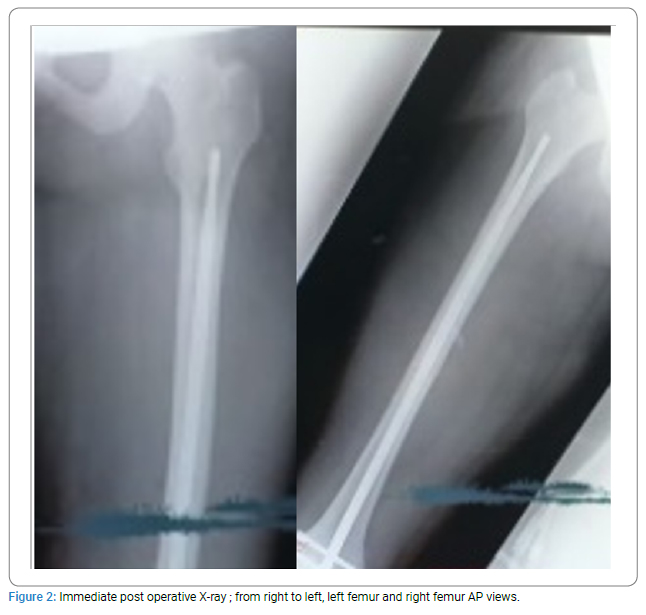
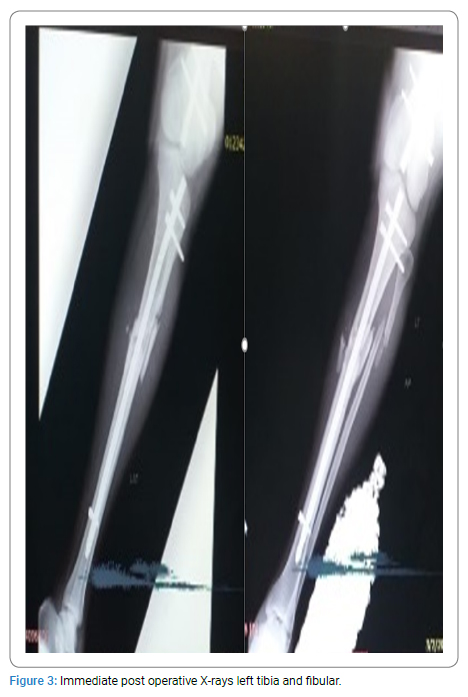
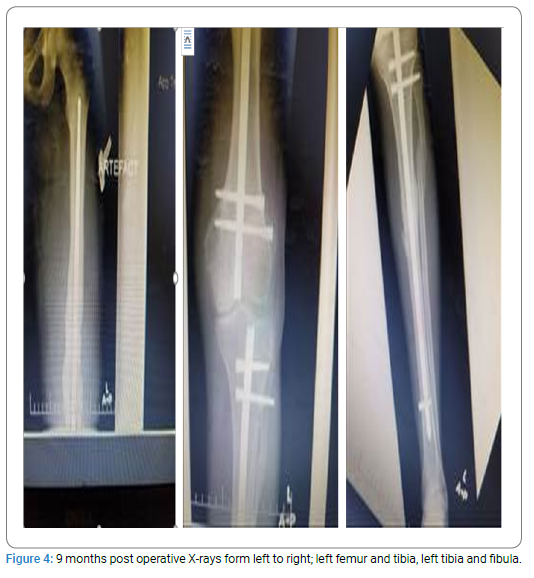
Imaging: All x-rays (Figure 1–Figure 4) of the limbs were done with the abdomen covered with a lead shield to minimize radiation exposure to the fetus.
An Abdominopelvic Ultrasound revealed a Single Viable Intrauterine Gestation with cephalic presentation and a posterior fundal placenta with adequate liquor.
She was diagnosed with an Open Gustilo Anderson IIIA midshaft fracture of the left femur with an ipsilateral open Gustilo Anderson IIIA fracture of the tibia and fibula, a closed midshaft fracture of the right femur, and a 28-week pregnancy with Rhesus incompatibility and hemorrhagic shock.
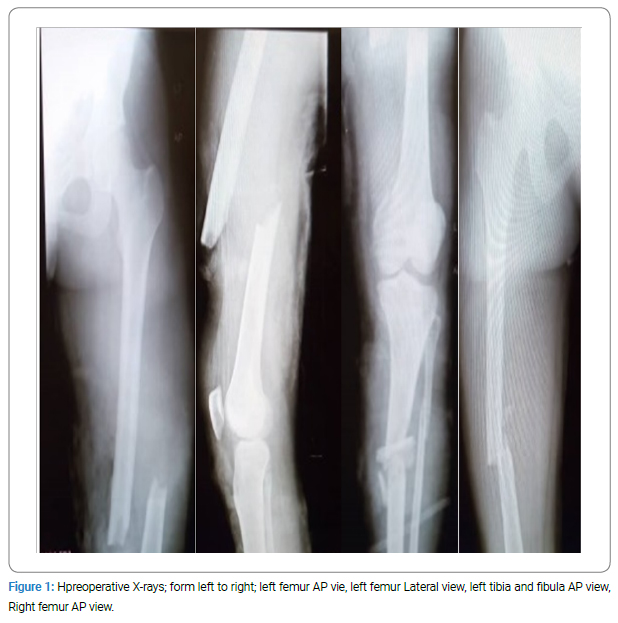
Patient Management: The patient was managed by a multidisciplinary team consisting of an emergency physician, obstetrician, anesthetist, and orthopedic surgeon. Shock was corrected with intravenous Ringer’s lactate and two units of O-negative blood (then four units subsequently to correct anemia). The fractures were initially immobilized with bilateral skin traction and an above-knee back slab on the left lower limb. Thromboprophylaxis included subcutaneous enoxaparin (Clexane 40 mg daily), antibiotic prophylaxis with 1.5 g IV Cefuroxime stat dose (administered within an hour of presentation), and analgesia.
Intramuscular dexamethasone was administered for 24 hours, and Rhogam was initiated on the second day and completed on the fourth day of admission. Fetal monitoring was done using daily kick counts and weekly ultrasonography.
The Patient and family were counseled for locked I.M. nailing of the Left femur, right femur, and left tibia with a clear emphasis on the possible complications of preterm delivery via cesarean section and the survival chances of the fetus under the situation. Debridement, initial stabilization, and wound cover were done within 4 hours of the initial injury. Definitive surgery was on admission day 12 due to difficulty in obtaining O-negative blood. After six units of packed cells, hemoglobin concentration reached 10.7 g/dl.
Spinal anesthesia was administered with the patient in the sitting position for both the emergent and definitive procedures. While the patient was being prepared for anesthesia, the fetal heart rate was checked at fifteen-minute intervals for rate and regularity. The patient was positioned supine with a 25 degrees–30 degrees tilt to the left to avoid pressure on the inferior vena cava by the gravid uterus for all procedures.
Retrograde intramedullary nailing (with stainless steel SIGN-Fin nails; (Figure 1,Figure 2) of the left and right femurs was done. The left tibia was nailed with a stainless-steel standard SIGN nail (Figure 3,Figure 4). The right femur, which was a closed fracture, was operated on first, then the left femur, and then the left tibia. All fractures were reduced open, avoiding the use of radiation. All fractures were reduced open, preventing the use of radiation.
Total surgery time was eighty-two (82) minutes with an estimated blood loss of 350 mLs. One unit of blood was given immediately post-surgery.
Surgery was Uneventful. Fetal heart Rate checked immediately post-surgery was 142 bpm and regular. No contractions were noticed.
The fetal heart rate, bleeding per vaginum, loss of liquor, and presence /absence of contractions were monitored four hourly daily, along with other constitutional parameters (blood pressure, Pulse rate, respiratory rate, and SPO2)
From postoperative day two, the patient received daily physiotherapy (range of movement of the knee). On postoperative day six, the patient was mobilized out of bed in a wheelchair. During this period, the obstetrics team conducted daily reviews and alternate-day ultrasonography.
The patient was referred to the obstetrics unit on postoperative day seven (30 weeks, five days). Clinical and sonographic monitoring continued until the patient was 38 weeks of gestation.
Range of motion in the right knee at 38 weeks = 0–130
Range of motion in the left knee at 38 weeks = 0–110
The patient was delivered vaginally following induction of labor at 38 weeks of gestation. Labor was uneventful.
Discussion
A national population-based study (1991–2001) conducted in Sweden reported a road traffic accident incidence of 207/100,000 pregnancies with an associated perinatal mortality of 3.7 per 100,000 pregnancies and a maternal mortality of 1.4 per 100,000 pregnancies (with an odds ratio of 3.55 compared with the background risk). Thus, mortality associated with trauma in pregnancy is high for both mother and child and was expected to be higher in a polytrauma Rhesus-negative pregnant woman in a low socioeconomic setting [4,6].
The outcome of trauma in pregnancy is especially grave for the fetus [1]. The degree of morbidity and mortality for the unrestrained pregnant woman is more grave. Early pregnancy is usually protected by the bony pelvis; an increase in the size of the gravid uterus, however, puts the fetus at risk of direct impact. The outcome of pregnancy, irrespective of gestational age, in trauma is determined primarily by the severity of maternal injury [2].
The cluster of challenges to mother, child, and all attending medical and non-medical staff spells out a conclusion that may be unfavorable at some level. Fortunately, that was not the outcome in our case, where we had a favorable outcome for both mother and child, especially a daring attempt at vaginal delivery.
Guidelines on managing obstetric trauma patients emphasize the need for a timely team approach if a favorable outcome is to be expected [1,6–8]. Maternal well-being is the priority, and any hope of saving the pregnancy hinges strongly on this factor [2,6,9]. Many protocols designed in developed nations encourage a multidisciplinary team coordinated by the emergency physician [6,7,9]. In this case, a multidisciplinary team was assembled from the initial resuscitative effort, with various teams making inputs at various stages depending on the therapeutic effort. For example, while orthopedic and trauma surgeons were prepared to manage the fractures, the specialty took center stage in coordinating treatment. While being prepared for delivery, however, the obstetric team took center stage.
The unique physiological adaptation of pregnancy presents a myriad of challenges for the attending team. Flavia et al, in their case report, noted that the bane of the multidisciplinary team was deciding on whether to operate and the timing of such intervention. In their report, they opted to manage the fractured tibia conservatively initially, then instituted operative management following a cesarean section forced by a preterm rupture of membranes. The decision to operate after the initial conservative path was not clearly stated. They, however, expressed worry about an increased risk of VTE due to the combined effects of pregnancy, trauma, and immobility [10]. Alternatively, Harold et al in their case series on femoral shaft fractures managed all the patients operatively with favorable outcomes. All had a gestational age of less than 32 weeks, and no obstetric complications were mentioned [1,9]. In this case, however, the decision for operative management was made early due to the multiplicity of fractures and the compounding effect of two being open. Maternal well-being was considered paramount.
Multiple factors come into play when deciding the timing of surgery, approach of intervention, and type of skeletal stabilization. Maternal well-being is paramount; fetal considerations are made only after that is secure. If survival of the mother is not feasible or death has occurred, an emergency hysterotomy may be life-saving for the fetus if performed promptly [9–11]. That said, the management of the pregnant trauma patient aims at achieving favorable outcomes for both mother and baby. Once maternal and fetal safety is assured after the initial resuscitation effort, further management will depend on the nature of the injury and gestational age [10–13].
The open fractures of the ipsilateral left femur and tibia, as well as the contralateral femoral shaft fracture sustained by our patient, were managed operatively, as this has been shown to have a more favorable outcome [13,14]. Sorbi et al. opted to manage their patient non-operatively for a closed minimally displaced tibia and fibular fracture presenting at 36 weeks. They believed that was the better path as the patient was closer to term and the literature had little information on the teratologic effects of anesthetic medication. They concede that the method may have increased the risk of DVT, though no specific literature relating to the occurrence of that complication in pregnancy with fractures was found in their literature review [10]. All three patients in a case series by Harold et al, presenting with femoral fractures of varying severity and etiology, were managed operatively with a favorable outcome. Two of the patients had general anesthesia, and one had axial anesthesia. In their review, the decision was based on the individual’s anesthetic requirements and not on the developing pregnancy, as no evidence at the time showed that teratologic complications occurred at those doses of anesthetics. All babies born were deemed normal [7]. `
While some studies have found no difference in terms of survival of the fetus comparing maternal age, gestational age, presence or absence of head, abdominal, and extremity injuries for matched groups, it is generally accepted that the presence of shock, advanced gestational and maternal age, and abnormal abdominal ultrasound findings often have bleak prospects [4,8,15–17]. The physiologic increase in blood volume and concomitant hemodilution may offer some benefit in maintaining circulatory pressure despite large volumes of blood loss. This change can be a disadvantage for the unsuspecting physician, as changes in systemic blood pressure can be precipitous. In addition, the gravid uterus beyond 20 weeks of gestation can compress the inferior vena cava, reducing venous return and increasing peripheral blood loss [4,13,15,17,18]. Our patient presented in shock. She was given intranasal oxygen with initial crystalloid, then a packed cell transfusion. She was nursed in the left lateral position during the initial resuscitation effort. A pillow was placed on the right side to keep the uterus away from the inferior vena cava while being nursed on the ward, and a 20 degrees to 30 degrees tilt of the theater table was employed during operative interventions. Adjuncts to the management of hemorrhage, such as tranexamic acid, have been shown to decrease mortality in nonpregnant trauma populations and indeed during the management of postpartum hemorrhage [4,13]. In addition to protocols observed in fixing long bone fractures, obstetric patients are positioned to avoid inferior vena cava compression and allow for diaphragmatic excursion [13,14]. The team decided to fix the long bone fractures open with intramedullary nails. The use of plates has previously been considered favorable as it was generally associated with less radiation [19]. The nails employed in this fixation were the Surgical Implant Generation network Fin and Standard nails. These nails allow for insertion and locking without the use of imaging [20]. The Fin was employed for both femoral fractures and the standard nail for the tibia fracture. This allowed for a reduced operating time and relatively less blood loss. Intravenous tranexamic acid was given at the start of surgery. It has been employed in the management of pregnant trauma patients even though there are no large trials to verify if it offers a comparative advantage, considering pregnancy itself is a procoagulable state.
Contributory factors to adverse obstetric outcomes include Rhesus-isoimmunization in Rhesus-negative women. It may affect the current pregnancy or, more commonly, subsequent pregnancies in women who get sensitized [5,13]. Generally, anti-D is recommended for Rhesus-negative pregnant women following trauma. The Kleihauer-Betke test and flow cytometry test have been suggested to be done routinely for all cases of pregnancy more than 12 weeks by some guidelines 63. The availability of these tests and their cost limit their use, however [13]. The patient had received the anti-D during her previous pregnancy, and hence the decision was made to continue with it.
Conclusion
Trauma in Pregnancy presents a lot of challenges to the mother, child, Trauma surgeon, Obstetrician, and Physiotherapist. Still, with careful planning and a well-coordinated, dedicated multidisciplinary management, a favorable outcome is always possible even amid other risk factors, as seen in this case study. This case study and the outcome emphasize the possibility of a favorable outcome for both mother and child, with already existing risks of: when to operate, type and duration of anesthesia, pain management, duration of surgery, and blood loss, and especially the survival of the child due to Rhesus incompatibility post-trauma and after delivery.
Conflict of Interest
The authors declare no potential conflicts of interest with respect to the research, authorship, and/or publication of this article. Informed consent was obtained for this publication.
References
- Kuhlmann RS, Cruikshank DP. Maternal Trauma during Pregnancy. Clin Obstet Gynecol. 1994;37(2): 274–293.
- Mendez-Figueroa H, Dahlke JD, Vrees RA, Rouse DJ. Trauma in pregnancy: An updated systematic review. Am J Obstet Gynecol. 2013;209(1):1–10.
- Abasi BE, Gabriel AM, Azubuike OC, Linus JA. Prevalence of Rhesus Negative Status Amongst Antenatal Atendees in the University of Uyo Teaching Hospital, Uyo, Nigeria: A 5-Year Review. Clin Med Res (NY). 2021;10(1):26.
- Weinberg L, Steele RG, Pugh R, Higgins S, Herbert M, Story D. The pregnant trauma patient. Anaesth Intensive Care. 2005;33(2):167–180.
- Osaro E, Charles AT. Rh isoimmunization in sub-saharan Africa indicates need for Universal access to anti-RhD immunoglobulin and effective management of d-negative pregnancies. Int J Womens Health. 2010;2(1):429–437.
- Petrone P, Talving P, Browder T, Teixeira PG, Fisher O, Lozornio A, et al. Abdominal injuries in pregnancy: A 155-month study at two level 1 trauma centers. Injury. 2011;42(1):47–49.
- Harold JA, Isaacson E, Palatnik A. Femoral fracture in pregnancy: A case series and review of clinical management. Int J Womens Health. 2019;11:267–271.
- Kajja I, Bimenya GS, Eindhoven B, Jan ten Duis H, Sibinga CTS. Blood loss and contributing factors in femoral fracture surgery. Afr Health Sci. 2010;10(1):18–25.
- Lavery JP, Staten-McCormick M. Management of moderate to severe trauma in pregnancy. Obstet Gynecol Clin North Am. 1995;22(1):69–90.
- Sorbi F, Sisti G, Di Tommaso M, Fambrini M. Traumatic tibia and fibula fracture in a 36 weeks’ pregnant patient: A case report. Ochsner Journal. 2013;13(4):547–549.
- Downing J, Sjeklocha L. Trauma in Pregnancy. Emerg Med Clin North Am. 2023;41(2):223–245.
- Hattori S, Hitosugi M, Moriguchi S, Baba M, Takaso M, Nakamura M, et al. Factors influencing pregnant women’s injuries and fetal loss due to motor vehicle collisions: A national crash data-based study. Healthcare (Basel). 2021;9(3):273.
- Jain V, Chari R, Maslovitz S, Farine D, Bujold E, Gagnon R, et al. Guidelines for the Management of a Pregnant Trauma Patient. J Obstet Gynaecol Can. 2015;37(6):553–574.
- Amezcua-Prieto C, Ross J, Rogozińska E, Mighiu P, Martínez-Ruiz V, Brohi K, et al. Maternal trauma due to motor vehicle crashes and pregnancy outcomes: A systematic review and meta-Analysis. BMJ Open. 2020;10(10):e035562.
- Aggarwal R, Soni KD; Trikha A. Initial management of a pregnant woman with trauma. Journal of Obstetric Anaesthesia and Critical Care. 2018;8(2):p 66–72.
- Santos JW, Grigorian A, Lucas AN, Fierro N, Dhillon NK, Ley EJ, et al. Predictors of fetal mortality in pregnant trauma patients. J Trauma Acute Care Surg. 2024;96(1):109–115.
- Sert ZS, Sert ET, Kokulu K. Predictors of obstetric complications following traumatic injuries in pregnancy. Am J Emerg Med. 2021:45:124–128.
- Kaplan S, Paschen HR. The pregnant trauma patient. Prehospital Trauma Care. 2001;33(2):451–470.
- O’Brien PJ. Fracture fixation in patients having multiple injuries. Can J Surg. 2003;46(2):124–128.
- Liu MB, Ali SH, Haonga BT, Eliezer EN, Albright PD, Morshed S, et al. Surgical implant generation network (SIGN) fin nail versus SIGN standard intramedullary nail for distal diaphyseal femur fractures treated via retrograde approach. Injury. 2019;50(10):1725–1730.
Keywords
Rhesus incompatibility; Multiple injuries; Multidisciplinary; Placenta abruption
Copyright
© 2025 Mohammed Bukari. This is an open access article distributed under the terms of the Creative Commons Attribution 4.0 International License (CC BY-4.0).
Cite this article
Bukari MIS, Asumah H, Adam M, Suoseg D, Tolgou Y, Buunaaim ADB. Outcome of a multiple-injured blood group O Rhesus-negative pregnant woman: a rare case report. Clin Case Rep J. 2025;6(2):1–6.