Long-Lasting and Well-Tolerated Response after Belinostat Treatment as Part of a Maintenance-Like Approach in a Case of Relapsed AITL
* Chara Giatra;
Anastasia Therapontos;
Pfoeve Rontogianni;
Ioannis Baltadakis;
Maria Bouzani;
-
* Chara Giatra: Department of Leukemia and Lymphoma, BMTU, Evangelismos General Hospital of Athens, Greece
-
Anastasia Therapontos: Department of Pathology, Evangelismos General Hospital of Athens, Greece
-
Pfoeve Rontogianni: Department of Nuclear Medicine, Evangelismos General Hospital of Athens, Greece
-
Ioannis Baltadakis: Department of Leukemia and Lymphoma, BMTU, Evangelismos General Hospital of Athens, Greece
-
Maria Bouzani: Department of Leukemia and Lymphoma, BMTU, Evangelismos General Hospital of Athens, Greece
Abstract
Among Peripheral T-cell lymphomas (PTCLs), T-follicular helper (TFH)-PTCLs are characterized by a common genetic profile and immunophenotype in their malignant cells. Notably, TFH-PTCLs harbor variants in genes involved in epigenetic regulation, suggesting that these entities may be sensitive to Histone Deacetylase Inhibitors (HDACis).
This report presents the case of a 79-year-old woman diagnosed with TFH-PTCL of Angioimmunoblastic-Type (AITL). The diagnosis was based solely on histopathological findings from a cervical lymph node biopsy. The expression of three TFH markers (PD-1, BCL6 and CXCL13), together with the typical morphological hallmarks of AITL, was identified in the patient’s biopsy. After receiving six cycles of a combination of 5-Azacitidine (5-AZA) and CHOP, the patient achieved a Complete Metabolic Response (CMR), which was not sustained. Treatment with belinostat, a pan-HDACi, assecond-line therapy resulted in a long-lasting and well-tolerated response. Interestingly, administering belinostat for 22 months after the patient reached a CMR proved successful as a maintenance-like strategy.
Introduction
Peripheral T-Cell Lymphomas (PTCLs) are rare non-Hodgkin lymphomas that originate from mature T-cells. They are highly heterogeneous in their presentation and are generally associated with poor outcomes. The latest World Health Organization (WHO) classification of hematolymphoid tumors describes more than 30 PTCLs subtypes [1]. One subgroup of PTCLs is derived from T-Follicular Helper (TFH) cells and is known as TFH-PTCL. This subgroup includes three subtypes: Angioimmunoblastic Type (AITL), follicular type, and Not Otherwise Specified (NOS) [1,2].
TFH-PTCLs share a common gene expression profile that includes variants affecting epigenetic regulator genes such as Isocitrate Dehydrogenase 2 (IDH2), DNA Methyltransferase 3A (DNMT3A), and Ten-Eleven Translocation 2 (TET2). They also share an immunophenotype characterized by the expression of Programmed Cell Death 1 (PD-1), CD10, BCL6, CXCL13, and inducible T-Cell Co-Stimulator (ICOS) markers [1–4]. AITL, which accounts for 15%–35% of PTCLs, is the most well-defined of the three TFH subtypes [4–6]. AITL mainly affects elderly patients, with a median age at diagnosis of approximately 65 years. It manifests clinically as generalized lymphadenopathy, B symptoms, hepatosplenomegaly, anemia, and hypergammaglobulinemia [5,7]. TFH-PTCLs are both rare and aggressive, making them difficult to manage therapeutically. The most prescribed first-line treatment is the CHOP regimen (cyclophosphamide, doxorubicin, vincristine, and prednisone) or a CHOP-like regimen. However, these therapies often do not result in durable responses and are associated with a 5-year Overall Survival (OS) rate of 30%–50% [5,7–9]. In recent years, expression of the CD30 antigen, which is often expressed at low levels, has been targeted by the CD30-directed antibody-drug conjugate brentuximab vedotin [10,11].
Relapsed/refractory (r/r) diseases are common, yet there is currently no clear consensus on the optimal therapeutic strategy for these cases. Physicians must therefore rely on clinical trials and existing treatment options, including Histone Deacetylase Inhibitors (HDACis) such as belinostat and romidepsin, the anti-folate agent pralatrexate, and the CD30-directed antibody-drug conjugate brentuximab vedotin [10,12–15].
Belinostat, an intravenous pan-HDACi, broadly inhibits all zinc-dependent HDAC enzymes (classes I, II, and IV) [16]. In 2014, the US Food and Drug Administration (FDA) approved belinostat for the treatment of patients with r/r PTCL based on results from the phase 2 BELIEF clinical trial [13]. This study observed the highest Overall Response Rate (ORR) (46%) and the longest responses in patients with AITL [13], suggesting that this TFH-PTCL subtype is particularly responsive to belinostat. This report presents the case of a patient with AITL who received 5-Azacitidine (5-AZA) and CHOP in combination asfirst-line therapy. The patient initially achieved a Complete Metabolic Response (CMR) before relapsing. So far, she has maintained a CMR for 24 months while receiving belinostat as second-line therapy.
Case Presentation
Medical history: In May 2023, a 79-year-old woman was admitted to the Leukemia and Lymphoma Department of Evangelismos General Hospital in Athens, Greece, after consulting an oncologist regarding left cervical and supraclavicular lymphadenopathy. She had no other relevant symptoms. The oncologist recommended a lymph node biopsy and referred her to our department.
Her medical history included a diagnosis of thyroid cancer in 2010, which was treated with thyroidectomy, followed by radioactive iodine therapy and thyroid hormone replacement therapy. The patient also underwent a total hysterectomy in 2014 and had a history of hypertension, which was treated with an angiotensin II receptor antagonist (160 mg daily). She reported an allergic reaction to beta-lactamantibiotics. At the time of diagnosis, her functional status was good (ECOG PS = 0).
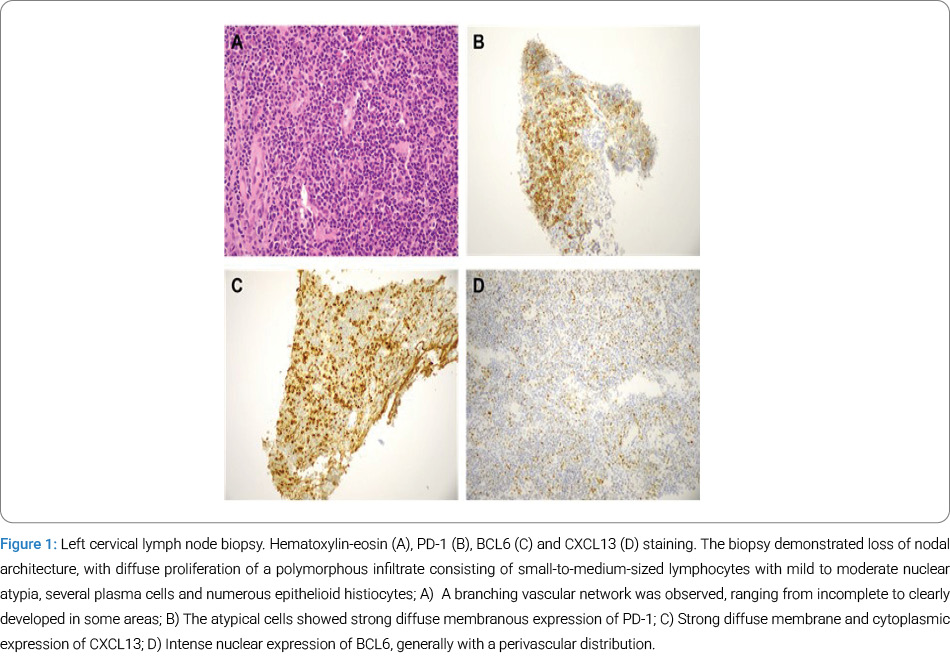
Diagnostic procedures: A biopsy of the left cervical lymph node performed on May 8, 2023, revealed an effacement of the lymph node architecture and an absence of germinal centers. A diffuse proliferation of a polymorphous infiltrate composed of small- to medium-sized lymphocytes with mild to moderate nuclear atypia and small amounts of clear cytoplasm was observed (Figure 1A). There were numerous small lymphocytes with mature morphology, as well as plasma cells with focal Russell bodies, a few eosinophils, and scattered larger cells with immunoblastic features. The presence of multiple epithelioid histiocytes forming microgranulomas, as well as incomplete or clearly defined deposits, was reported. A dense, branching vascular network was observed. Scattered mitoses and apoptotic bodies were present, but no necrosis was observed. No cells exhibiting the morphological features of Hodgkin cells were identified.
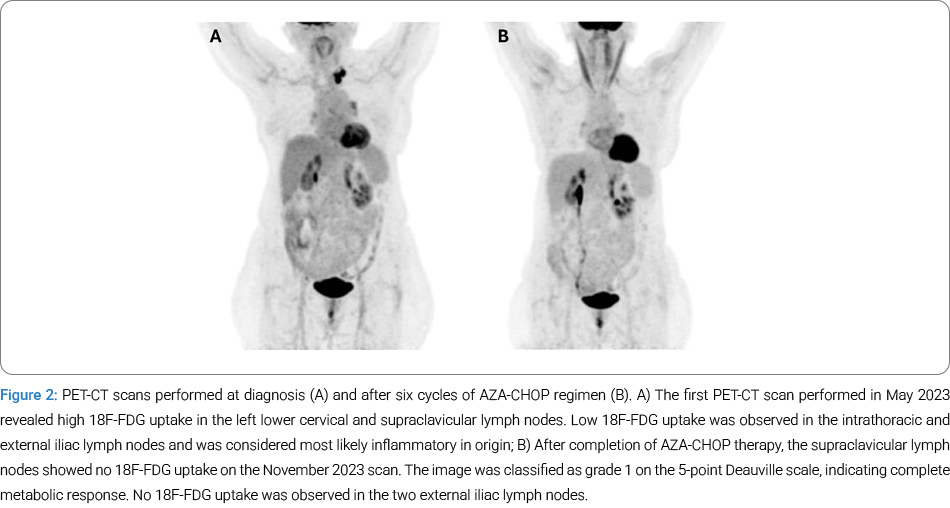
Atypical lymphocytes tested positive for CD2, CD3, CD4, CD5, CD7, CD43, BCL2, BCL6, PD-1, and CXCL13, (Figure 1B,Figure 1C,Figure 1D) and negative for PAX5, CD20, CD79a, CD10, cyclin D1, and IRTA. The small lymphocytes predominantly belonged to the B-cell lineage (PAX5+, CD20+, CD79a+), and, to a lesser extent, to the cytotoxic T-cell subset (CD3+, CD8+, TIA+, granzyme+). Plasma cells showed polytypic expression of light chains, with a kappa-to-lambda ratio of approximately 1:1.2. The immunoblasts were CD20+, PAX5+, CD30+, CD15±, MUM1+, and OCT2+. Immunostaining with CD21 and CXCL13 revealed hyperplasia of the dendritic cell network. The Ki-67 proliferation index was estimated at 45%–50%. A Positron Emission Tomography-Computed Tomography (PET-CT) scan performed on May 22, 2023, revealed abnormal 18-fluorodeoxyglucose (18F-FDG) uptake in a group of lymph nodes in the left lower cervical and supraclavicular regions (SUVmax: 12.5) (Figure 2A). The intrathoracic lymph nodes (tracheal [SUVmax, 2.9], pulmonary hila [SUVmax, 4.6], subtracheal [SUVmax, 3.6]) and the external iliac lymph nodes (SUVmax: 3.8) exhibited low 18F-FDG uptake, likely due to inflammatory changes. The only abnormality observed in the laboratory results was an elevated beta-2 microglobulin level.
On June 23, 2023, the patient was diagnosed with stage IIA nodal TFH-PTCL angioimmunoblastic type according to the Lugano classification [17].
Treatment and outcomes: As first-line treatment, the patient received a combination of oral 5-AZA (300 mg, Day 1 to Day 14) and CHOP (cyclophosphamide [750 mg/m2, Day 15], doxorubicin [50 mg/m², Day 15], vincristine [1 mg, Day 15] and prednisolone [100 mg, Day 15 to Day 19]) in 21-day cycles until September 2023. After six cycles of this treatment, a CMR was observed on the PET-CT scan performed in November 2023. The scan showed no 18F-FDG uptake in the supraclavicular lymph nodes, resulting in a score of 1 on the Deauville 5-point scale (Figure 2B). The patient experienced grade 3 neutropenia during her treatment with 5-AZA plus CHOP, which resolved with filgrastim therapy (5 mg/kg, once weekly).
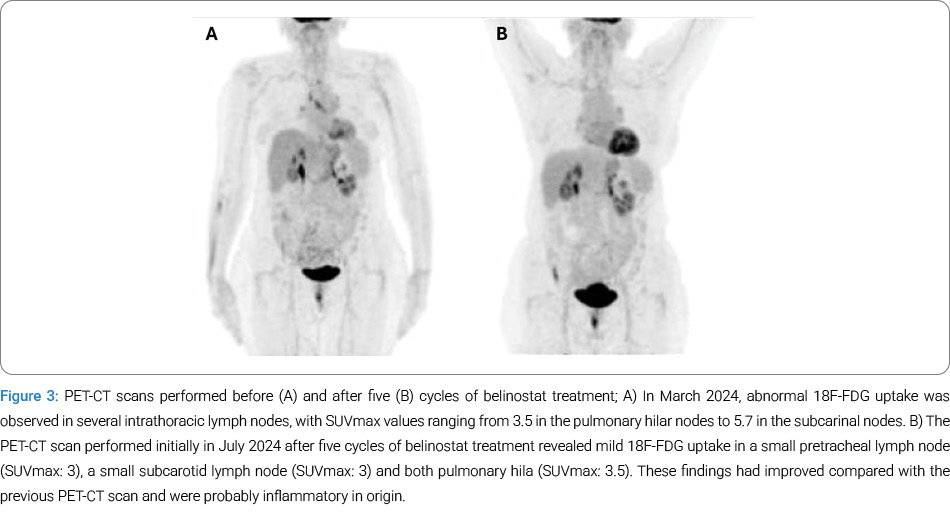
Five months later, in early March 2024, mediastinal lymphadenopathy was discovered during a routine follow-up examination conducted every three months, indicating lymphoma relapse. The PET-CT scan revealed abnormal 18F-FDG uptake in several intrathoracic lymph nodes, with SUVmax values ranging from 3.5 to 5.7 (Figure 3A). Although these findings were likely due to inflammatory causes, they required clinical evaluation and monitoring. The patient remained symptomatic.
In April 2024, the patient started belinostat (1,000 mg/m², Day 1 to Day 5) in 21-day cycles as second-line therapy. By the end of July, a PET-CT scan showed decreased 18F-FDG uptake in the intrathoracic lymph nodes compared to the prior scan (Figure 3B), indicating a CMR. However, the observed lymph node uptake was still considered potentially attributable to an inflammatory process. At the time of this report, the patient remains on belinostat treatment and has received a total of 31 cycles. The most recent PET-CT scan performed in October 2025 confirmed a long-lasting response. The patient did not report any clinically significant adverse events during belinostat treatment.
Discussion
Of the three subtypes of TFH-PTCL, AITL is the most extensively studied and, consequently, the most well-defined. This case of AITL was diagnosed based solely on a histopathological assessment of a lymph node biopsy without clinical suspicion. According to the 2022 WHO classification, the TFH phenotype is characterized by the antigenic expression of at least two TFH markers, in addition to CD4, by malignant cells [1]. The five immunophenotypic markers recommended for testing in cases of suspected TFH lymphoma are PD-1, CD10, BCL6, CXCL13, and ICOS, with PD-1 and ICOS being the most highly expressed markers [1–3]. In this case, the diagnosis relied on tumor expression of PD-1, BCL6, and CXCL13, coupled with histology. The morphological hallmarks of AITL found in the patient’s biopsy included effacement of the lymph node architecture, medium-sized lymphoid cells with clear cytoplasm, a prominent microenvironment composed of eosinophils, plasma cells, histiocytes and large immunoblastic cells, as well as an increased vascular network and expansion of follicular dendritic cells [4,1,3].
In addition to immunophenotypic features, TFH-PTCL entities exhibit a shared common gene expression pattern that is characteristic of TFH cells. These lymphomas show variants in T-cell receptor (TCR)-related genes (CD28), in genes encoding epigenetic regulators (TET2, DNMT3A, and IDH2), and in RHOA (RHOAG17V) [4,3]. Therefore, genomic testing via high-throughput sequencing (HTS) of gene panels can be useful for establishing mutational profiles and supporting diagnoses in challenging cases [18]. Notably, IDH2 mutations are uncommon in follicular and NOS subtypes, in contrast to the AITL subtype [4,19,20].
In the first-line setting, the CHOP or CHOP-like regimen remains the standard of care for TFH-PTCL [9,21]. The decision to combine oral 5-AZA with CHOP as the patient’s initial therapy was based on the promising outcomes demonstrated in a multicenter phase 2 study involving 21 patients with untreated PTCL [22]. An overall Complete Response (CR) rate of 75% was observed (n = 20 patients), reaching 88% for the TFH-PTCL subtype (n = 17 patients). After a median follow-up period of 21 months, the 2-year Progression-Free Survival (PFS) and OS rates were 69% and 76%, respectively, for patients with the PTCL-TFH subtype [22]. The rationale for using the hypomethylating agent 5-AZA in TFH-PTCL is based on the central role of epigenetic dysregulation in its pathophysiology. This dysregulation involves the hypermethylation of genes that play a role in T-cell differentiation and TCR signaling [23]. Priming with 5-AZA before CHOP is expected to improve chemosensitization and response to therapy. The upregulation of genes involved in apoptosis and inflammation, as observed with 5-AZA, may sensitize the tumor microenvironment [22]. During treatment with the 5-AZA-CHOP combination, the patient experienced grade 3 neutropenia, which was consistent with the previously reported hematologic toxicity profile [22].
The long-term prognosis for patients with AITL is poor, with a high rate of r/r disease and a 5-year OS rate of 30%–40% [5,9,24]. A prospective cohort study of 937 patients with PTCL in the International T-Cell Lymphoma Project found that relapse occurred at a median time of eight months after first-line treatment [25]. Despite achieving a CMR, the patient relapsed within five months of completing first-line therapy. Notably, relapse was detected during routine follow-up, while the patient was asymptomatic, which highlights the importance of close surveillance in patients at high risk of relapse. According to ESMO and EHA guidelines, patients who do not undergo stem cell transplantation consolidation should undergo a history and physical examination every three months for one year and every six months for two additional years [21].
This clinical case illustrates the challenge of managing aggressive PTCL with chemotherapy alone due to the high relapse rate following initial treatment. Many patients who are not eligible for transplantation still receive salvage chemotherapy, although its effectiveness is limited. A significant proportion of PTCL patients are elderly or have significant comorbidities, so they cannot undergo an allogeneic transplantation. Consequently, they have a poor prognosis and a short life expectancy under current standards of care. Management is particularly challenging in patients who respond to first-line therapy but are not eligible for an allogeneic transplantation. The heterogeneity of PTCL and the lack of well-defined treatment strategies for each subtype further complicate decision-making for these patients. Clinicians often have few therapeutic options available, and salvage chemotherapy often has a poor response rate. There is also unclear guidance across PTCL subtypes [21,25,26].
Because epigenetic dysregulation plays a role in the pathogenesis of TFH-PTCL, treatment with an HDACi is an attractive therapeutic approach that could help maintain response in patients who are not eligible for allogeneic transplantation. Several clinical studies have evaluated the potential efficacy of this class of therapeutics for treating PTCL [13,27–30]. A recent meta-analysis of 22 prospective clinical studies demonstrated the pooled efficacy of romidepsin, belinostat, and chidamide in monotherapy or in combination with conventional regimens for treating patients with untreated (7 studies) and r/r (16 studies) PTCL [31]. In the r/r indication, the highest pooled ORR was observed in AITL, reaching 44%. The pivotal phase 2 BELIEF study, which involved 120 patients with r/r PTCL, found that belinostat monotherapy at a dose of 1,000 mg/m² on Day 1 to Day 5 every 21 days induced a similar ORR (46%) in the AITL subgroup [13]. In summary, belinostat has shown particularly encouraging results in AITL.
A multicenter retrospective cohort study of 127 patients with r/r AITL or PTCL-NOS demonstrated that the TFH phenotype is an independent predictor of response to HDAC as a single agent or in combination [32]. Greater responsiveness to HDACi has been hypothesized to be linked to the presence of TFH-related mutations (TET2, and/or DNMT3A, and/or RHOA) [32]. Interestingly, of the 12 variables, response to first-line chemotherapy (CR or partial response [PR]) was the only other factor, besides the TFH phenotype, associated with a better ORR to HDACis [32], which our patient had.
Patients with r/r PTCL have a poor prognosis, with median PFS and OS of only a few months [33]. At the time of writing this report, the patient had maintained a response for 24 months, which is much longer than the median value of seven months reported by Ghione et al. [32]. Long-lasting responses to belinostat are well documented, ranging from at least twelve months to 45 months [13,32,34–37]. In this case, belinostat was used in a “maintenance-like“ approach, with therapy continued so far for 26 cycles beyond the CMR achieved after five cycles. To our knowledge, only one other case of successful maintenance-like treatment with belinostat in the context of r/r PTCL has been published. A patient with refractory PTCL received 28 cycles of belinostat, including 26 cycles after reaching a CR, resulting in eight months of disease-free survival after treatment discontinuation [35]. Due to belinostat’s favorable safety profile, its long-term use appears feasible in selected patients, as illustrated by four other published cases of r/r PTCL [35,36,38]. A systematic review of 16 studies involving 512 patients with r/r malignancies treated with belinostat monotherapy found that belinostat was associated with a grade ≥3 hematologic toxicity rate of less than 10% [39].
Conclusions
This case of AITL, which relapsed rapidly after initial treatment with the 5-AZA-CHOP combination despite achieving a CMR, highlights the difficulty clinicians face in identifying an effective first-line therapeutic strategy for PTCL. Using belinostat as second-line therapy led to a CMR after five cycles. Continuing belinostat as a maintenance-like strategy has stabilized the lymphoma for 24 months, without notable adverse effects. Belinostat is an appropriate treatment option for patients with r/r AITL, particularly those who are ineligible for transplantation and require long-term therapy with a high tolerability profile.
Key Clinical Message
This case of angioimmunoblastic TFH-PTCL relapsed rapidly following first-line therapy with the 5-AZA-CHOP combination. Second-line therapy with belinostat, a pan-HDAC inhibitor, induced a complete metabolic response after five cycles. Continued treatment as a maintenance-like approach has stabilized the lymphoma for 25 months to date and has been well tolerated.
Disclosures
Acknowledgments: The authors would like to thank Florence Boulmé, PhD, for writing assistance.
Ethics approval and informed patient consent: This case report was published with the patient’s written informed consent, including consent for publication.
Funding: The publication of this work was sponsored by IDEOGEN AG (Switzerland).
Authors’ contributions: All authors contributed to manuscript preparation and reviewed the final version.
Conflict of Interest
The authors declare no potential conflicts of interest with respect to the research, authorship, and/or publication of this article. Informed consent was obtained for this publication.
References
- Alaggio R, Amador C, Anagnostopoulos I, Attygalle AD, de Oliveira Araujo IB, Berti E, et al. The 5th edition of the world health organization classification of haematolymphoid tumours: lymphoid neoplasms. Leukemia. 2022;36(7):1720–1748.
- Campo E, Jaffe ES, Cook JR, Quintanilla-Martinez L, Swerdlow SH, Anderson KC, et al. The international consensus classification of mature lymphoid neoplasms: a report from the clinical advisory committee. Blood. 2022;140(11):1229–1253.
- Ondrejka SL, Amador C, Climent F, Ng SB, Soma L, Zamo A, et al. Follicular helper T-cell lymphomas: disease spectrum, relationship with clonal hematopoiesis, and mimics. A report of the 2022 EA4HP/SH lymphoma workshop. Virchows Arch. 2023;483(3):349–365.
- Chiba S, Sakata-Yanagimoto M. Advances in understanding of angioimmunoblastic T-cell lymphoma. Leukemia. 2020;34(10):2592–2606.
- de Leval L, Parrens M, Le Bras F, Jais JP, Fataccioli V, Martin A, et al. Angioimmunoblastic T-cell lymphoma is the most common T-cell lymphoma in two distinct French information data sets. Haematologica. 2015;100(9):e361–e364.
- Vose J, Armitage J, Weisenburger D; International T-Cell Lymphoma Project. International peripheral T-cell and natural killer/T-cell lymphoma study: pathology findings and clinical outcomes. J Clin Oncol. 2008;26(25):4124–4130.
- Advani RH, Skrypets T, Civallero M, Spinner MA, Manni M, Kim WS, et al. Outcomes and prognostic factors in angioimmunoblastic T-cell lymphoma: final report from the international T-cell Project. Blood. 2021;138(3):213–220.
- Ruan J, Chen Z, Larson MC, Bennani NN, Allen P, Mou E, et al. Patterns of care and clinical outcomes in systemic peripheral T-cell lymphoma: the LEO-MER prospective cohort study. Blood Adv. 2026;10(10):3480–3493.
- Federico M, Rudiger T, Bellei M, Nathwani BN, Luminari S, Coiffier B, et al. Clinicopathologic characteristics of angioimmunoblastic T-cell lymphoma: analysis of the international peripheral T-cell lymphoma project. J Clin Oncol. 2013;31(2):240–246.
- Horwitz S, O’Connor OA, Pro B, Trümper L, Iyer S, Advani R, et al. The ECHELON-2 Trial: 5-year results of a randomized, phase III study of brentuximab vedotin with chemotherapy for CD30-positive peripheral T-cell lymphoma. Ann Oncol. 2022;33(3):288–298.
- Moskowitz AJ, Stuver RN, Horwitz SM. Current and upcoming treatment approaches to common subtypes of PTCL (PTCL, NOS; ALCL; and TFHs). Blood. 2024;144(18):1887–1897.
- Coiffier B, Federico M, Caballero D, Dearden C, Morschhauser F, Jäger U, et al. Therapeutic options in relapsed or refractory peripheral T-cell lymphoma. Cancer Treat Rev. 2014;40(9):1080–1088.
- O’Connor OA, Horwitz S, Masszi T, Van Hoof A, Brown P, Doorduijn J, et al. Belinostat in patients with relapsed or refractory peripheral T-cell lymphoma: results of the pivotal phase ii belief (CLN-19) study. J Clin Oncol. 2015;33(23):2492–2499.
- O’Connor OA, Pro B, Pinter-Brown L, Bartlett N, Popplewell L, Coiffier B, et al. Pralatrexate in patients with relapsed or refractory peripheral T-cell lymphoma: results from the pivotal PROPEL study. J Clin Oncol. 2011;29(9):1182–1189.
- Coiffier B, Pro B, Prince HM, Foss F, Sokol L, Greenwood M, et al. Results from a pivotal, open-label, phase II study of romidepsin in relapsed or refractory peripheral T-cell lymphoma after prior systemic therapy. J Clin Oncol. 2012;30(6):631–636.
- Miller TA, Witter DJ, Belvedere S. Histone deacetylase inhibitors. J Med Chem. 2003;46(24):5097–5116.
- Cheson BD, Fisher RI, Barrington SF, Cavalli F, Schwartz LH, Zucca E, et al. Recommendations for initial evaluation, staging, and response assessment of Hodgkin and non-Hodgkin lymphoma: the Lugano classification. J Clin Oncol. 2014;32(27):3059–3068.
- de Leval L, Alizadeh AA, Bergsagel PL, Campo E, Davies A, Dogan A, et al. Genomic profiling for clinical decision making in lymphoid neoplasms. Blood. 2022;140(21):2193–2227.
- Dobay MP, Lemonnier F, Missiaglia E, Bastard C, Vallois D, Jais JP, et al. Integrative clinicopathological and molecular analyses of angioimmunoblastic T-cell lymphoma and other nodal lymphomas of follicular helper T-cell origin. Haematologica. 2017;102(4):e148–e151.
- Odejide O, Weigert O, Lane AA, Toscano D, Lunning MA, Kopp N, et al. A targeted mutational landscape of angioimmunoblastic T-cell lymphoma. Blood. 2014;123(9):1293–1296.
- d’Amore F, Federico M, de Leval L, Ellin F, Hermine O, Kim WS, et al. Peripheral T- and natural killer-cell lymphomas: ESMO-EHA Clinical Practice Guideline for diagnosis, treatment and follow-up. Ann Oncol. 2025;36(6):626–644.
- Ruan J, Moskowitz A, Mehta-Shah N, Sokol L, Chen Z, Kotlov N, et al. Multicenter phase 2 study of oral azacitidine (CC-486) plus CHOP as initial treatment for PTCL. Blood. 2023;141(18):2194–2205.
- Wang C, McKeithan TW, Gong Q, Zhang W, Bouska A, Rosenwald A, et al. IDH2R172 mutations define a unique subgroup of patients with angioimmunoblastic T-cell lymphoma. Blood. 2015;126(15):1741–1752.
- Tokunaga T, Shimada K, Yamamoto K, Chihara D, Ichihashi T, Oshima R, et al. Retrospective analysis of prognostic factors for angioimmunoblastic T-cell lymphoma: a multicenter cooperative study in Japan. Blood. 2012;119(12):2837–2843.
- Bellei M, Foss FM, Shustov AR, Horwitz SM, Marcheselli L, Kim WS, et al. The outcome of peripheral T-cell lymphoma patients failing first-line therapy: a report from the prospective, International T-Cell Project. Haematologica. 2018;103(7):1191–1197.
- Foley NC, Mehta-Shah N. Management of peripheral T-cell lymphomas and the role of transplant. Curr Oncol Rep. 2022;24(11):1489–1499.
- Bachy E, Camus V, Thieblemont C, Sibon D, Casasnovas RO, Ysebaert L, et al. Romidepsin plus CHOP versus CHOP in patients with previously untreated peripheral T-cell lymphoma: Results of the Ro-CHOP phase III study (conducted by LYSA). J Clin Oncol. 2022;40(3):242–251.
- Foss F, Advani R, Duvic M, Hymes KB, Intragumtornchai T, Lekhakula A, et al. A Phase II trial of Belinostat (PXD101) in patients with relapsed or refractory peripheral or cutaneous T-cell lymphoma. Br J Haematol. 2015;168(6):811–819.
- Rai S, Kim WS, Ando K, Choi I, Izutsu K, Tsukamoto N, et al. Oral HDAC inhibitor tucidinostat in patients with relapsed or refractory peripheral T-cell lymphoma: phase IIb results. Haematologica. 2023;108(3):811–821.
- O’Connor OA, Özcan M, Jacobsen ED, Roncero JM, Trotman J, Demeter J, et al. Randomized Phase III Study of Alisertib or Investigator’s Choice (Selected Single Agent) in Patients With Relapsed or Refractory Peripheral T-Cell Lymphoma. J Clin Oncol. 2019;37(8):613–623.
- Yang P, Tao Y, Zhao A, Shen K, Li H, Wang J, et al. Efficacy and safety of histone deacetylase inhibitors in peripheral T-cell lymphoma: a systematic review and meta-analysis on prospective clinical trials. Front Oncol. 2023;13:1127112.
- Ghione P, Faruque P, Mehta-Shah N, Seshan V, Ozkaya N, Bhaskar S, et al. T follicular helper phenotype predicts response to histone deacetylase inhibitors in relapsed/refractory peripheral T-cell lymphoma. Blood Adv. 2020;4(19):4640–4647.
- Mak V, Hamm J, Chhanabhai M, Shenkier T, Klasa R, Sehn LH, et al. Survival of patients with peripheral T-cell lymphoma after first relapse or progression: spectrum of disease and rare long-term survivors. J Clin Oncol. 2013;31(16):1970–1976.
- Camus V, Etancelin P, Drieux F, Veresezan EL, Picquenot JM, Penther D, et al. Complete hematologic response after belinostat treatment and allogeneic stem cell transplantation for multiple relapsed/refractory angioimmunoblastic T-cell lymphoma: A case report. Clin Case Rep. 2023;11(6):e7623.
- Reimer P, Chawla S. Long-term complete remission with belinostat in a patient with chemotherapy refractory peripheral T-cell lymphoma. J Hematol Oncol. 2013;6:69.
- Atalay F, Yeşilaltay A. Long-term successful use of belinostat in a patient with relapsed-refractory angioimmunoblastic lymphoma who has previously been heavily treated. J Cancer Res Ther. 2024;20(3):1049–1052.
- De Wilde S, Graux C. Complete hematologic response in a patient with multiple pretreated angioimmunoblastic T-cell lymphoma after belinostat therapy followed by allogeneic stem cell transplantation: A case report. Clin Case Rep. 2024;12(7):e9159.
- Santagostino A, Dyhia H, Gavril D, Lucania G, Misra S, Almohuanna K, et al. Challenging Management of Relapsed/Refractory Angioimmunoblastic T-Cell Lymphoma: Insights from Two Complex Cases with Long-Term Response to Belinostat. Ann Case Report. 2024;9:2059.
- Allen PB, Lechowicz MJ. Hematologic toxicity is rare in relapsed patients treated with belinostat: a systematic review of belinostat toxicity and safety in peripheral T-cell lymphomas. Cancer Manag Res. 2018;10:6731–6742.
Cite this article
Giatra C, Therapontos A, Rontogianni P, Baltadakis I, Bouzani M. Long-Lasting and Well-Tolerated Response after Belinostat Treatment as Part of a Maintenance-Like Approach in a Case of Relapsed AITL. Clin Case Rep J. 2026;7(3):1–6.
Keywords:
Peripheral T-cell lymphoma; TFH-PTCL; AITL; belinostat; HDAC inhibitor
Copyright:
© 2026 Maria Bouzani. This is an open access article distributed under the terms of the Creative Commons Attribution 4.0 International License (CC BY-4.0).