Aquaporin-4 Antibody Positive Transverse Myelitis Following Varicella Zoster Virus Reactivation in a Patient with Multiple Sclerosis Treated with Fingolimod
* Nahayati MA;
Salehi Torabi K;
Azimi Saeen A;
Baghaei M;
-
* Nahayati MA: Department of Neurology, Mashhad University of Medical Sciences, Mashhad, Iran
-
Salehi Torabi K: Faculty of Medicine, Birjand University of Medical Science, Birjand, Iran
-
Azimi Saeen A: Multiple Sclerosis Research Center, Neuroscience Institute, Tehran University of Medical Sciences, Tehran, Iran
-
Baghaei M: Department of Radiology, Mashhad University of Medical Sciences, Mashhad, Iran
Abstract
We report the case of a 47-year-old woman with a prior diagnosis of definite Multiple Sclerosis who developed transverse myelitis following reactivation of the Varicella Zoster Virus during fingolimod treatment. The patient presented with radicular pain, sensory loss, urinary incontinence, and weakness. Spinal imaging revealed a long segment lesion extending from the cervical to the thoracic spinal cord. Cerebrospinal Fluid analysis revealed signs of inflammation, and elevated virus-specific antibodies suggested reactivation despite negative viral DNA testing.
Her condition did not improve with high-dose corticosteroids and plasmapheresis. Subsequent testing revealed the presence of Aquaporin-4 antibodies, confirming the diagnosis of Neuromyelitis Optica Spectrum Disorder (NMOSD). Treatment with cyclophosphamide led to partial recovery, and long-term therapy with rituximab was initiated.
This case illustrates how viral reactivation with immunosuppressive therapy may unmask or trigger neuromyelitis optica in patients previously diagnosed with Multiple Sclerosis. This study highlights the importance of reconsidering the diagnosis in MS patients with atypical attacks and the need to consider comorbid diagnoses to guide effective treatment. Early distinction between demyelinating conditions that overlap is essential for timely and appropriate management.
Abbreviations
AQP4: Aquaporin-4; CSF: Cerebrospinal Fluid; IgG: Immunoglobulin G; LETM: Longitudinally Extensive Transverse Myelitis; MRI: Magnetic Resonance Imaging; MS: Multiple Sclerosis; NMO: Neuromyelitis Optica; NMOSD: Neuromyelitis Optica Spectrum Disorder; VZV: Varicella Zoster Virus
Introduction
Neuromyelitis Optica (NMO) is an autoimmune disorder characterized by demyelination of the central nervous system, with Aquaporin-4 (AQP4) water channels identified as the primary target antigens. The identification of novel clinical and radiological features in patients who test positive for AQP4 antibodies has broadened the understanding of NMO, leading to the adoption of the term Neuromyelitis optica spectrum disorder (NMOSD). However, the precise cause of NMOSD remains an active area of scientific inquiry [1–3]. Current research endeavors aim to deepen our understanding of the underlying mechanisms of NMOSD, striving to pave the way for more precisely targeted therapeutic interventions. NMOSD is characterized by an autoimmune response in which the immune system mistakenly targets the optic nerves, spinal cord, and, occasionally, the brain [4]. This aberrant immune response specifically targets AQP4, a protein abundantly present in these regions. According to the latest 2015 guideline recommendations, NMOSD can be diagnosed if at least one of six established core clinical criteria is fulfilled. In addition, the diagnosis requires the presence of Immunoglobulin G (IgG) autoantibodies targeting AQP4 water channels in the patient’s serum [5]. Conversely, Multiple Sclerosis (MS) is the predominant immune-mediated inflammatory demyelinating ailment of the central nervous system [6,7]. Notably, Sphingosine-1-Phosphate (S1P) receptor modulators, emerging as a class of oral disease-modifying therapies for MS, exhibit immunosuppressive properties, thereby increasing the susceptibility of patients to specific infections [8–10]. This work focuses on the association between drugs of this type and infections, including Varicella Zoster Virus (VZV), Herpes Simplex Virus (HSV), and Cryptococcus neoformans. Distinguishing VZV myelitis from AQP4-IgG-positive NMOSD, particularly when there is a herpes zoster antecedent, is critical for the pre-implementation of judicious treatment protocols [3]. This study contributes to the existing literature by reporting a rare complication involving the VZV in a patient concurrently diagnosed with MS, under fingolimod treatment, with Longitudinally Extensive Transverse Myelitis (LETM).
The potential progression of the disease to NMOSD or an attack resembling MS could be attributed to the VZV. The divergent treatment modalities associated with each disorder underscore the need to differentiate between NMOSD and MS.
Case Presentation
We report a 47-year-old MS woman who presented with vesicular rash in T4–T7 dermatomes, erythema, pain, and allodynia in the dermatome in 2017. Since 2010, according to McDonald’s criteria, the diagnosis of high-risk Clinically Isolated Syndrome (CIS) was made, and INTERFERON B 1A (AVONEX) was prescribed [11]. Since 2015, because of ataxia and vertigo, and an active brain Magnetic Resonance Imaging (MRI) at that time, she switched to fingolimod. And after 2 years of fingolimod,she complained of severe right cervical radicular pain. Three weeks after treatment of zoster with valacyclovir, she developed asymmetric paraparesis.
On neurological examination, the patient had brisk reflexes in the lower limbs, extensor plantar responses bilaterally, and asymmetric paraparesis 3/5–4/5, more severe on the left, as well as sensory impairment for temperature and pain at the trunk below the Th10 level. There was also urine incontinence. Vital signs were normal.
A spinal MRI conducted before the VZV infection revealed the presence of only a solitary lesion. Spinal MRI after VZV infection demonstrated a longitudinal, T2-hyperintense lesion extending from C7 to Th9 with marked edema and gadolinium enhancement (Figure).
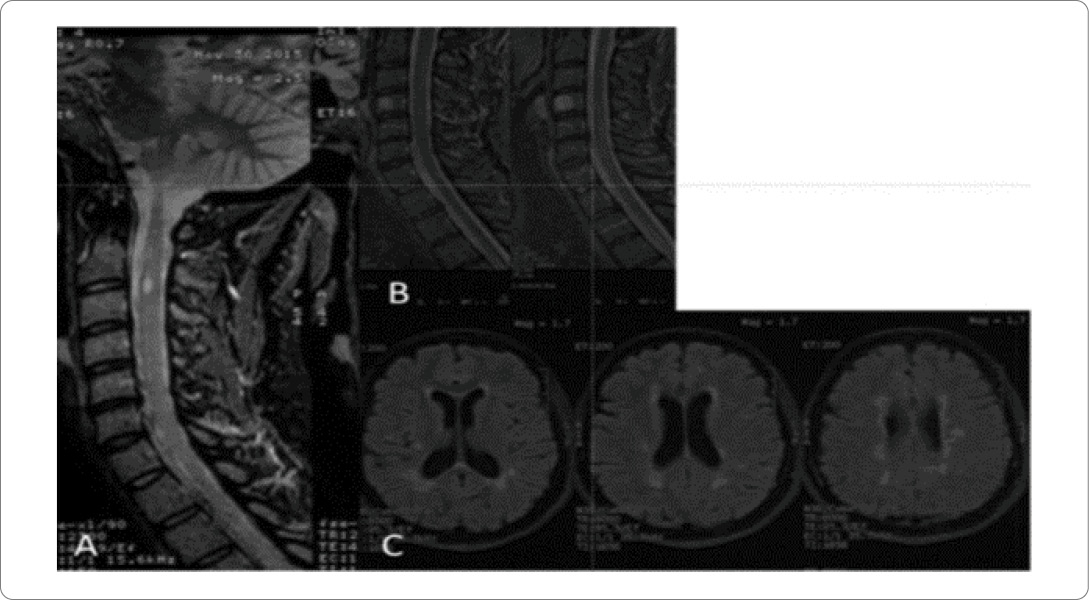
Cerebrospinal Fluid (CSF) analysis revealed lymphocytic pleocytosis (9 cells/μL; normal range, 0 cells/μL–5 cells/μL), elevated total protein (81.1 mg/dl; normal range, 15 mg/dl–46 mg/dl). Oligoclonal bands were present, with four bands detected in CSF but absent in serum. Polymerase Chain Reaction (PCR) testing was negative for Varicella Zoster Virus (VZV) deoxyribonucleic acid (DNA), Cytomegalovirus (CMV), herpes simplex virus (HSV), and Human Immunodeficiency Virus (HIV). Serological testing showed VZV IgG positivity prior to the acute episode and elevated anti-VZV IgG levels in CSF, consistent with intrathecal antibody synthesis. Testing for autoimmune disease markers, serum vitamin B12, Angiotensin-Converting Enzyme (ACE), and HIV yielded normal or negative results.
High-dose intravenous methylprednisolone was administered for 5 consecutive days after infectious etiologies were excluded, and CSF analysis confirmed the absence of active infection. One week later, while the patient was still receiving methylprednisolone, serum testing with the ELISA method revealed antibodies against AQP4. Given the exclusion of infectious causes, the absence of clinical improvement, and a growing suspicion of Neuromyelitis Optica (NMO), plasmapheresis was initiated.
Despite undergoing 7 plasmapheresis sessions, the patient showed no neurological improvement. Due to this atypical clinical course and no response to medication, a 1 g pulse of cyclophosphamide was administered for recovery from the attack. Over the following month, the patient’s neurologic status gradually improved, although mild residual left leg paresis (4/5 strength) and impaired pain and temperature sensation in the right lower limb persisted.
This case is particularly notable because LETM occurred after a herpes zoster infection and could easily have been misdiagnosed as post-herpetic myelitis. However, the presence of AQP4 antibodies confirmed a diagnosis of NMOSD. Considering the active disease course, the coexistence of NMOSD and MS, and the positive AQP4-IgG, we initiated treatment with rituximab and began a gradual tapering of corticosteroids.
The patient provided written informed consent for publication. Institutional Review Board (IRB) approval was obtained before submission.
Discussion
NMOSD is a rare autoimmune demyelinating disease of the central nervous system that predominantly affects AQP4 water channels [1,2]. The presence of AQP4-IgG serves as both a diagnostic indicator and a pathogenic trigger for NMOSD, and an external trigger—often an infection—may precipitate clinical onset. Infections, including VZV, have been reported in up to one-third of patients before NMOSD presentation [12].
Although previous reports have documented the potential for VZV reactivation to trigger NMOSD [13], our case is notable because it involves a young woman with MS who developed Longitudinally Extensive Transverse Myelitis (LETM) following VZV reactivation while on fingolimod treatment. The timing and context suggest that fingolimod-induced immunosuppression likely enabled VZV reactivation, which triggered NMOSD. The virological work-up supported this hypothesis, with elevated anti-VZV IgG levels in the CSF, consistent with intrathecal synthesis. Despite corticosteroids and plasmapheresis, she showed no motor recovery, prompting the prescribing of cyclophosphamide [14].
Fingolimod impairs immune surveillance by sequestering CD4+ T cells in lymph nodes, potentially reducing the host’s ability to control latent viruses, such as VZV. While CD8+ T-cell–mediated immunity is largely preserved, the imbalance in T-cell function may contribute to viral reactivation and subsequent CNS involvement [15–17].
To the best of our knowledge, this is the first reported case of AQP4-positive NMOSD in a patient with MS following VZV reactivation under fingolimod treatment. This underscores the importance of re-evaluating the diagnosis in patients with MS with poor treatment response and atypical presentations [18]. Comprehensive antibody screening, including AQP4-IgG, should be performed.
Conclusion
This case illustrates the potential of NMOSD to emerge in a patient with MS following VZV reactivation under fingolimod. This study emphasizes the need for diagnostic vigilance and considering another autoimmune disorder involving the CNS, like NMOSD,for people with MS and atypical symptoms and MRI. Early identification of NMOSD enables prompt, targeted treatment and may prevent further neurological decline. Broader recognition of infectious triggers and immune modulation risks is essential for the management of overlapping demyelinating disorders.
Patient Consent
Written informed consent was obtained from the patient for publication of this case report and accompanying images.
Funding
This research received no specific grant from any funding agency in the public, commercial, or not-for-profit sectors
Acknowledgements
The authors declare that there were no contributors requiring acknowledgement in this work.
Conflict of interest
The author declares no potential conflicts of interest with respect to the research, authorship, and/or publication of this article. Informed consent was obtained for this publication.
References
- Heerlein K, Jarius S, Jacobi C, Rohde S, Storch-Hagenlocher B, Wildemann B. Aquaporin-4 antibody-positive longitudinally extensive transverse myelitis following varicella zoster infection. J Neurol Sci. 2009;276(1–2):184–186.
- Dutra BG, da Rocha AJ, Nunes RH, Jr Martins Maia AC. Neuromyelitis optica spectrum disorders: spectrum of MR imaging findings and their differential diagnosis. Radiographics. 2018;38(1):169–193.
- Eguchi H, Takeshige H, Nakajima S, Kanou M, Nakajima A, Fuse A, et al. Herpes zoster radiculomyelitis with aquaporin-4 antibodies: a case report and literature review. Front Neurol. 2020;11:585303.
- Ciccarelli O, Cohen JA, Reingold SC, Weinshenker BG; International Conference on Spinal Cord Involvement and Imaging in Multiple Sclerosis and Neuromyelitis Optica Spectrum Disorders. Spinal cord involvement in multiple sclerosis and neuromyelitis optica spectrum disorders. Lancet Neurol. 2019;18(2):185–197.
- Wingerchuk DM, Banwell B, Bennett JL, Cabre P, Carroll W, Chitnis T, et al. International Panel for NMO Diagnosis. International consensus diagnostic criteria for neuromyelitis optica spectrum disorders. Neurology. 2015;85(2):177–189.
- Raine CS. Multiple sclerosis: immune system molecule expression in the central nervous system. J Neuropathol Exp Neurol. 1994;53(4):328–337.
- Mahad DH, Trapp BD, Lassmann H. Pathological mechanisms in progressive multiple sclerosis. Lancet Neurol. 2015;14(2):183–193.
- Sharma K, Chaudhary D, Beard K, Srivastava S, Khalid SH, Sriwastava S. A comprehensive review of varicella-zoster virus, herpes simplex virus, and cryptococcal infections associated with sphingosine-1-phosphate receptor modulators in multiple sclerosis patients. Mult Scler Relat Disord. 2022;59:103675.
- Cohen JA, Barkhof F, Comi G, Hartung HP, Khatri BO, Montalban X, et al. Oral fingolimod or intramuscular interferon for relapsing multiple sclerosis. N Engl J Med. 2010;362(5):402–415.
- Kappos L, Radue EW, O’Connor P, Polman C, Hohlfeld R, Calabresi P, et al. A placebo-controlled trial of oral fingolimod in relapsing multiple sclerosis. N Engl J Med. 2010;362(5):387–401.
- Vuurst de Vries RMV, Mescheriakova JY, Wong YYM, Runia TF, Jafari N, Samijn JP, et al. Application of the 2017 revised McDonald criteria for multiple sclerosis to patients with a typical clinically isolated syndrome. JAMA Neurol. 2018;75(11):1392–1398.
- Jarius S, Ruprecht K, Wildemann B, Kuempfel T, Ringelstein M, Geis C, et al. Contrasting disease patterns in seropositive and seronegative neuromyelitis optica: a multicentre study of 175 patients. J Neuroinflammation. 2012;9:14.
- Hua Y, Xu A, Huang H, Xia S, Chen J, Lu S, et al. Aquaporin-4 antibody-positive neuromyelitis optica spectrum disorder triggered by herpes zoster: a case report and literature review. J Int Med Res. 2024;52(11):3000605241281690.
- Wang L, Liu K, Tan X, Zhou L, Zhang Y, Liu X, et al. Remedial effect of intravenous cyclophosphamide in corticosteroid-refractory patients in the acute phase of neuromyelitis optica spectrum disorder-related optic neuritis. Front Neurol. 2021;11:612097.
- Lungu O, Annunziato PW, Gershon A, Staugaitis SM, Josefson D, LaRussa P, et al. Reactivated and latent varicella-zoster virus in human dorsal root ganglia. Proc Natl Acad Sci USA. 1995;92(24):10980–10984.
- Arvin AM, Wolinsky JS, Kappos L, Morris MI, Reder AT, Tornatore C, et al. Varicella-zoster virus infections in patients treated with fingolimod: risk assessment and consensus recommendations for management. JAMA Neurol. 2015;72(1):31–39.
- Sallusto F, Geginat J, Lanzavecchia A. Central memory and effector memory T cell subsets: function, generation, and maintenance. Annu Rev Immunol. 2004;22:745–763.
- Obeidat AZ, Jacob C, Zabeti A. Concurrent Dawson’s Fingers and Area Postrema Lesion in a Mixed Neuroimmune Disorder. Can J Neurol Sci. 2017;44(4):452–454.
Cite this article
Salehi Torabi K, Azimi Saeen A, Nahayati MA, Baghaei M. Aquaporin-4 antibody positive transverse myelitis following varicella zoster virus reactivation in a patient with multiple sclerosis treated with fingolimod. Clin Case Rep J. 2026;7(3):1–4.
Keywords
NMOSD; Multiple sclerosis; Varicella zoster virus; Fingolimod; AQP4-antibody; Longitudinal myelitis
Copyright
© 2026 Nahayati MA. This is an open access article distributed under the terms of the Creative Commons Attribution 4.0 International License (CC BY-4.0).