Abstract
This article is a continuation of the 2017 article “Acute Myocarditis: A Rare Complication After Black Widow Spider Bite.” During the warm months of the year, bites from the black widow spider may occur. It can be challenging to accurately diagnose these bites because patients may not be able to identify the specific arachnid responsible. Diagnosis is typically made by the correlation of the examining clinical symptoms and laboratory results.
We present in this article the case of a 22-year-old male bitten by a black widow spider with severe symptoms, the establishment of the clinical diagnosis, and the benefits of using antivenin for both the patient and the healthcare system.
Abbreviations
AST: Aspartate Aminotransferase; ALT: Alanine Aminotransferase; LDH: Lactate Dehydrogenase; CK: Creatine Kinase; CK-MB: Imuno Creatine Kinase-MB Fraction; INR: International Normalized Ratio
Introduction
Spiders in this genus are commonly known as Widow Spiders. There are more than 30 species, distributed on all continents except Antarctica. The most common in Europe is Latrodectus tredecimguttatus or European Widow [1].
In Albania, there is also the species L. tredecimguttatus (Rossi, 1790), known as the “Mediterranean Black Widow”. The body and legs of this spider are black and covered with small velvety hairs. Sexual dimorphism is evident in that males are much smaller than females, with a black color, round abdomen, and long legs. Females are easily identified by the red spots on the back of the abdomen [2].
α-Latrotoxin is another potent toxin targeting the molecular machinery of exocytosis, with a high affinity for receptors expressed specifically on neuronal and endocrine cells [3]. α-Latrotoxin (α-LTX) from black widow spider venom induces exhaustive release of neurotransmitters from vertebrate nerve terminals and endocrine cells. This 130-kDa protein has been employed for many years as a molecular tool to study exocytosis. However, its action is complex: in neurons, α-LTX induces massive secretion both in the presence of extracellular Ca2+ (Ca2+e) and in its absence; in endocrine cells, it usually requires Ca2+ [4].
These spiders do not often transmit any communicable disease. Ulcerations at spider bite sites are due to the combination of cytotoxicity from the venom components and autoimmune responses from lymphocytes and cytokines. The symptoms of the spider bite include itching, pain, and blisters; these can be separate or associated with systemic manifestations, namely muscle pain or cramping, sweating, headache, fever, breathing difficulty, anxiety, and hypertension [5].
Systemic latrodectism is more severe in large muscular adults, the very young, elderly, and those with co-morbidities. Systemic features including GI upset, sweating, hypertension and headache can develop after one hour, but may be delayed for up to 12 hours. Cardiac features include tachycardia followed by bradycardia, ST depression and QT prolongation. Troponin may be raised.
Electrolyte abnormalities include hyper- and hypokalaemia, hyperphosphataemia and hyponatremia, which may be exacerbated if the patient is dehydrated. Transient hyperglycemia can also occur. Rare symptoms include rhabdomyolysis, myocarditis, peripheral neuropathy, demyelination, trismus, dysuria, ptosis and priapism. Hallucinations and delirium have also been reported.
Symptoms frequently fluctuate in severity for up to 4 days; however, they may last up to 2 weeks. Persistent foot drop and neuropathic pain for over 7 months after envenoming has been reported [1].
Case Presentation
A 22-year-old male patient was admitted at 02:40 pm to the University Hospital with a medical epicrisis transferred from a regional hospital with the diagnosis of “Probable spider insect bite”, with discomfort in the third toe of the right foot, pain in the right testicle, hypertension, stomach ache, and thirst. In the medical history, the patient stated that he was admitted to the emergency room of the district hospital with pain in the lower extremity and right testicle.
The patient lived in a small agricultural town in the center of the country. It was suspected that he may have been bitten by an insect on his lower right extremity while putting on his shoes at around 9.30 am. Still, he did not attach significance to the incident and did not provide any information about the type of insect to the medical staff. Since the clinic initially reported severe pain in the lower extremity and in the right testicle, without providing information about an insect bite, the main suspicion in the district hospital was torsion of the testicle. The lack of correlation of clinical and laboratory data, echo-abdominal rate without local changes, the occurrence of profuse sweating, increased blood pressure that does not correspond to age, and local changes around the bite site prompted the medical staff of the regional hospital to suspect a black spider bite and to address the patient in the university hospital.
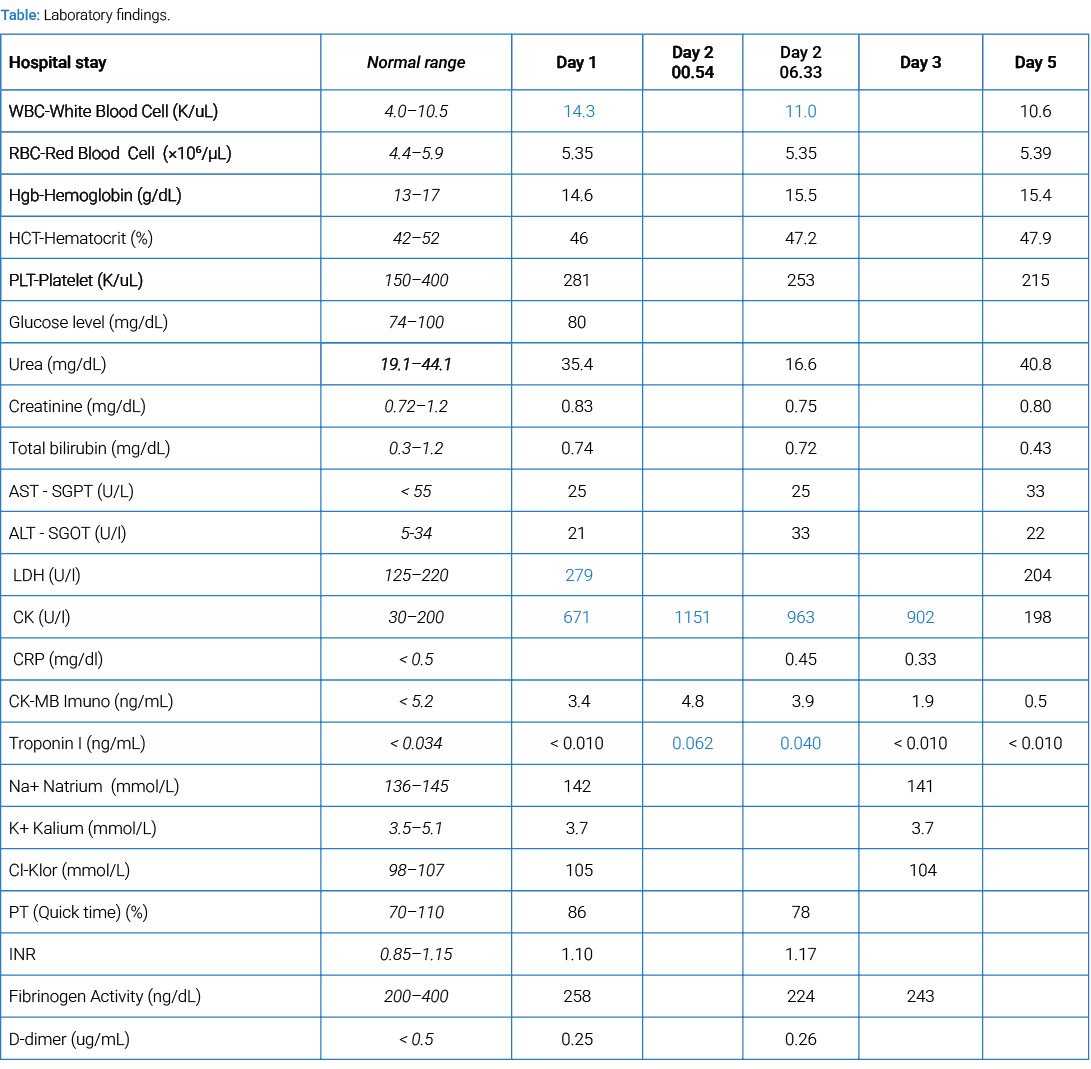
Laboratory findings: In the time of coming in the hospital were: White Blood Cell count: 14.3 K/uL (Neutrofile: 12.2 K/uL, Lymphocytes: 0.9 K/uL, Monocytes: 0.9 K/uL), Red Blood Cell count: 5.35 × 10⁶/mm³, Hemoglobin 14.6 g/dL, Platelet: 281 K/uL, Hematocrit: 46.0%, Glucose: 80 mg/dL, Urea level: 35.4 mg/dL, Creatinine: 0.83 mg/dL, Alanine Aminotransferase (ALT): 25 U/L, Aspartate Aminotransferase (AST): 29 U/L, Gamma gt: 21 U/L, Lactate dehydrogenase (LDH): 279 U/L, Creatine kinase (CK): 671 U/L, Imuno Creatine Kinase-MB Fraction (CK-MB): 3.4 ng/mL, Troponin level: < 0.010 ng/mL, Cholinesterase: 9142 U/L, International Normalized Ratio (INR): 1:10, Prothrombin level (Quick time): 86%, Fibrinogen Activity: 258 mg/mL, D-Dimer: 0.25 ug/mL. Potassium level: 3.7 mmol/L, Sodium level: 142 mmol/L (Table).
Abdominal Echo: Hepar with homogeneous structure.Cholecyst with free bile ducts. Kidney with normal structure, without stasis. Bladder with normal structure. Minimal liquid at the bottom of the sides. Tests with normal echostructures, with vascularization present. Normal bilateral hydrocele.
ECG: Sinus rhythm, Cardiac frequency 75 bpm, aspects of BDD suspect. Without specific changes of ST-T. Two hours after presentation to the university hospital and about six to seven hours after the bite, the patient presented severe symptoms: alteration of consciousness, severe generalized discomfort, muscular cramps, generalized fasciculations, excessive sweating, hyperthermia.
Lactodectus mactant Bite (Black Widow Spider Bite) was diagnosed based on clinical and anamnestic data, as well as local alterations in the bite region. The patient was moved to the intensive care unit.
Based on the patient’s clinical condition, his young age, and the confirmation of the diagnosis, the team of resuscitators and toxicologists chose to administer the anti-Lactodectus mactant antivenin around nine hours after the bite.
At 19.40, antivenom was applied. At 22.00, after the application of antivenin, the patient’s complaints and vital parameters were relieved.
Following the application of antivenin, the patient’s overall state appears calm and stable. Conscious, oriented, and not complaining of particular muscle or abdominal discomfort. Skin and mucous membranes are lightly coloured and with reduced scleral hyperemia. Rhythmic heart rate. FC = 82/min, BP = 121/62 mmHg. Lungs with bilateral vesicular respiration, oxygen saturation of 98%, no dyspnoea, tachypnoea or oxygen assistance. Abdomen is smooth and painless. The temperature is 37.1 0C. Diuresis was monitored.
The patient’s condition stabilized 15 hours after he was brought to the Intensive Care Unit and antivenin was administered; he was then transferred to the Clinical Toxicology Service without exhibiting any particular pathognomonic indications. The patient had clinical and analytical assessments while he was in the ward to ensure his care. Corticosteroids, vitamin therapy, and antibiotic therapy are the mainstays of treatment. The patient was discharged from the hospital after five days. The total length of hospitalization was six days.
Cardiac ECHO: Left ventricle with endo-cavitary dimensions and normal Sinus Frequency, without visible disturbances of segmental kinetics. Aortic and tricuspid valve, opening and gradient in rate. Pericardium without liquid.
Discussion
Spider bites most commonly occur on the extremities. Black widow spider bites often elicit intense agony at the location of the bite, but in this case, the victim was unaware he had been bitten. The venom of the black widow spider can produce a wide range of clinical symptoms, from local harm to life-threatening illnesses.
Antivenom administration is one of the modalities of therapy for black widow spider bites; it has been produced in the United States since 1936, especially in severe envenomation, which can decrease the duration and intensity of the pain [5].
Conclusion
The clinical diagnosis of the patient was established after correlating anamnestic and clinical data with laboratory results. The condition of the patient during his presentation at the hospital was critical, for this reason, he was hospitalized in the intensive care unit. The application of antivenin significantly improved the patient’s clinical condition; there were no long-term systemic complications, and it reduced his hospital stay.
According to the 2017 article “Acute Myocarditis: A Rare Complication After Black Widow Spider Bite,” the case of a young girl who was bitten by a black widow spider and whose clinical condition was similar to the current patient, the application of antivenin stopped the progression of clinical symptoms and improved the patient’s clinical condition and laboratory analyses. This patient’s outcome was outstanding, particularly when discovered early and carefully handled. The hospital length of stay and treatment costs were decreased. The situation was handled accurately and professionally, which is an attribute of the health-care system.
Conflicts of Interest
The authors declare no potential conflicts of interest with respect to the research, authorship, and/or publication of this article. Informed consent was obtained for this publication.
Cite this article
Marko I, Marko S, Preci R, Muca E, Alimehmeti I. Benefits of Applying Antivenin to Black Widow Spider Bite. Clin Case Rep J. 2026;7(4):1–4.
Keywords
Black widow spider; Antivenin; α-Latrotoxin
Copyright
© 2026 Irena Marko. This is an open access article distributed under the terms of the Creative Commons Attribution 4.0 International License (CC BY-4.0).