Severe Exercise-Induced Rhabdomyolysis Requiring Hospitalization in a Mother and Daughter Following a Single High-Intensity Spinning Session: A Case Report
* Bipin Chaurasia;
Luana Bolfer da Silva;
Caio Bolfer da Silva;
Larissa Cuminati Delatorre;
Renato Fedatto Beraldo;
-
* Bipin Chaurasia: Department of Neurosurgery, Neurosurgery Clinic, Birgunj, Nepal
-
Luana Bolfer da Silva: UNOESTE – FAMEPP, Faculdade de Medicina de Presidente Prudente, Presidente Prudente, SP, Brazil
-
Caio Bolfer da Silva: UNOESTE – FAMEPP, Faculdade de Medicina de Presidente Prudente, Presidente Prudente, SP, Brazil
-
Larissa Cuminati Delatorre: UNOESTE – FAMEPP, Faculdade de Medicina de Presidente Prudente, Presidente Prudente, SP, Brazil
-
Renato Fedatto Beraldo: Department of Neurosurgery, Santa Casa de Misericórdia de Presidente Prudente, Presidente Prudente, SP, Brazil
-
Nov 04, 2026 |
-
Volume: 7 |
-
Issue: 5 |
-
Views: 78 |
-
Downloads: 92 |
Abstract
Exercise-induced rhabdomyolysis results in the release of Creatine Phosphokinase (CPK) and myoglobin into the bloodstream, causing muscle pain, weakness, and dark-colored urine. Severe presentations requiring hospitalization are uncommon, and simultaneous occurrence in family members is particularly rare. We report a case of severe rhabdomyolysis in a mother and daughter following a single high-intensity exercise session.
Introduction
Exercise-induced rhabdomyolysis is a condition characterized by acute skeletal muscle breakdown following intense physical activity, resulting in the release of creatine phosphokinase (CPK) and myoglobin into the bloodstream. Typical symptoms include muscle pain, weakness, swelling, and dark-colored urine [1–3].
While most cases are mild, severe rhabdomyolysis requiring hospitalization is rare, and simultaneous occurrence in family members has been scarcely reported.
We present a rare case of simultaneous exercise-induced rhabdomyolysis in a 48-year-old mother and her 20-year-old daughter following a single high-intensity spinning session in Brazil. Laboratory evaluation revealed markedly elevated CPK levels in both patients, accompanied by transient elevations in AST (TGO) and ALT (TGP), and mild urinary abnormalities, consistent with acute muscle injury without renal impairment.
Case Presentation
We report a 20-year-old female and her 48-year-old mother, both previously healthy, with no comorbidities and not taking any medications. Both developed severe thigh muscle pain, generalized weakness, and dark-colored urine within 72 hours after a single 45-minute high-intensity spinning session.On physical examination, both patients presented with tenderness and mild swelling of the thighs.
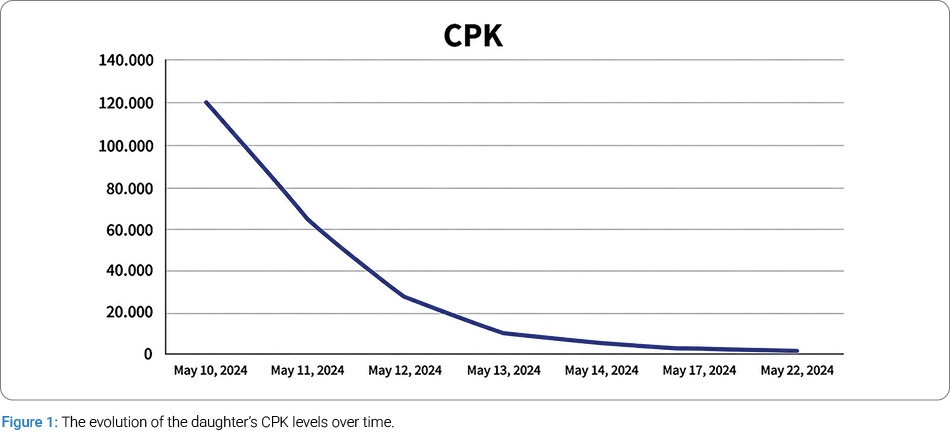
Methods (Differential diagnosis, investigations and treatment): Below are the daughter’s laboratory results (Table 1). To better visualize the trend in muscle enzyme elevation, the daughter’s CPK levels over time are presented in (Figure 1). The daughter’s laboratory findings reflect acute skeletal muscle injury induced by high-intensity exercise. Her CPK peaked at 20,863 U/L, indicating significant muscle fiber breakdown, and declined rapidly over the following days, allowing safe discharge once clinical and laboratory improvement was observed [1,2].
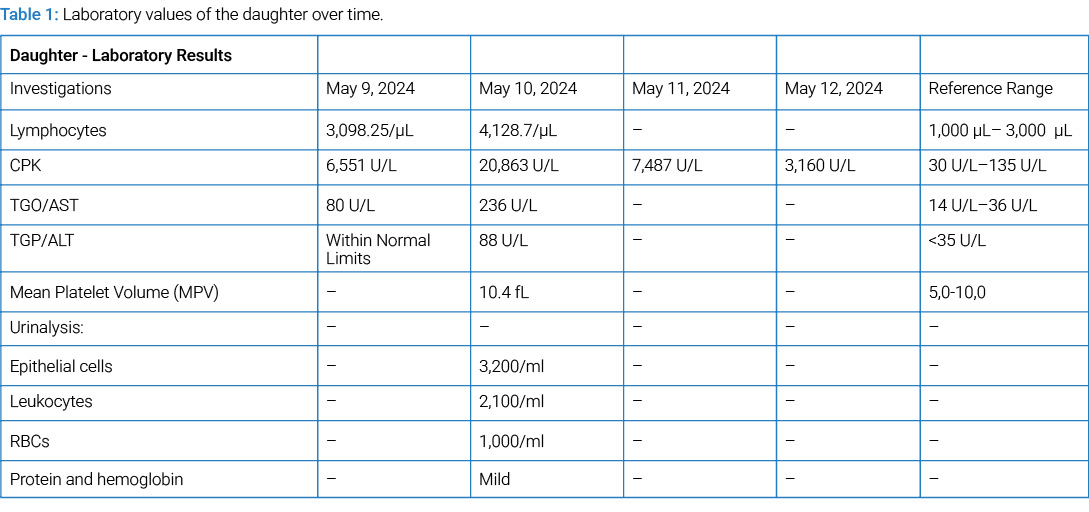
AST (TGO) and ALT (TGP) elevations were mild and paralleled CPK levels, suggesting a muscle origin rather than hepatic injury [3,4]. Mild lymphocytosis likely reflects a transient inflammatory or stress response [5]. Urinalysis showed mild proteinuria and hematuria, consistent with muscle breakdown products. Renal function remained normal, likely due to early hydration and monitoring [2,6].
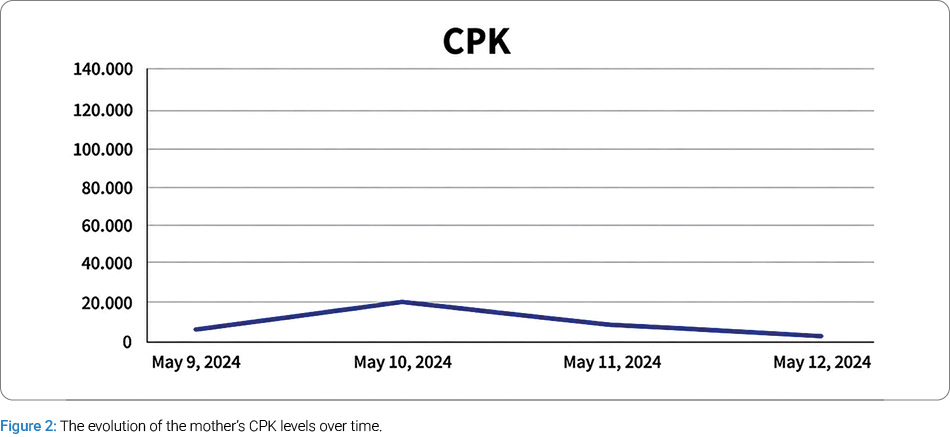
Below are the mother’s laboratory results (Table 2). To better visualize the trend in muscle enzyme elevation, the mother’s CPK levels over time are presented in (Figure 2). In the mother, laboratory findings were more pronounced, reflecting severe muscle injury. Her CPK peaked at 119,428 U/L, with parallel elevations in AST (TGO) and ALT (TGP), consistent with muscle-derived enzyme release rather than primary hepatic injury [3,4].
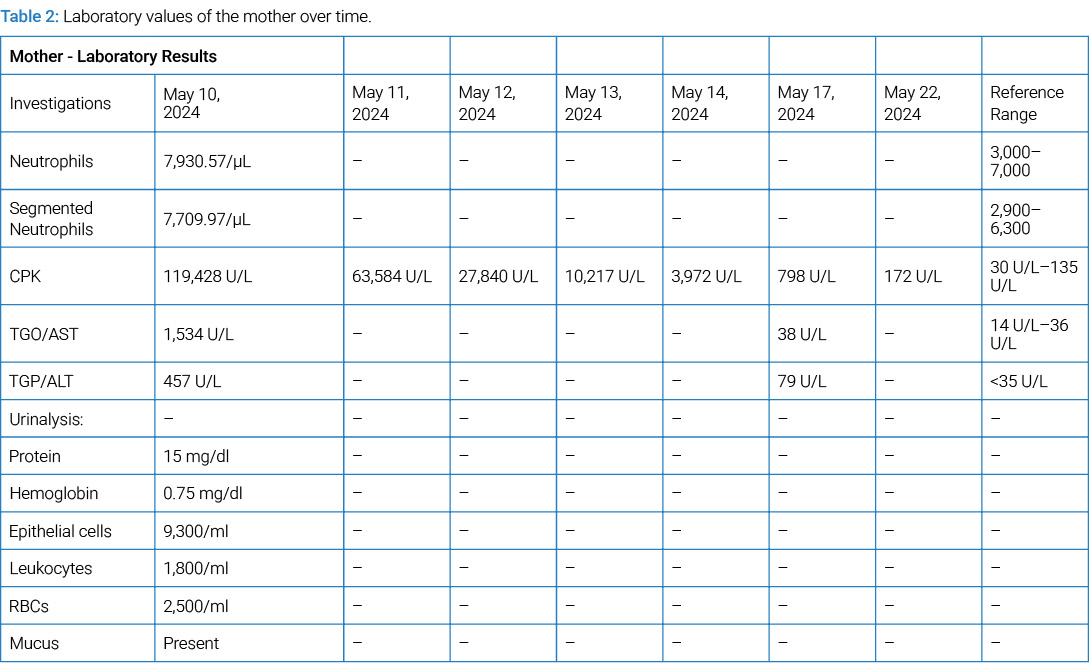
Mild neutrophilia was observed, likely representing a systemic inflammatory response [5]. Urinalysis findings were similar to the daughter’s, with mild proteinuria and hemoglobinuria. Renal function remained preserved due to timely supportive management [2,6].
CPK levels gradually normalized over approximately 12 days, demonstrating complete recovery with appropriate treatment.
Discussion
Exercise-induced rhabdomyolysis is characterized by skeletal muscle breakdown following intense physical activity, leading to the release of intracellular components, including CPK, myoglobin, and transaminases, into the bloodstream [1,2]. While mild cases are relatively common, severe rhabdomyolysis requiring hospitalization is rare. Simultaneous occurrence in family members is extremely unusual.
Both patients in this report developed significant elevations in CPK following a single high-intensity spinning session. The simultaneous presentation suggests a possible familial or genetic predisposition, although no specific underlying disorder was identified. Early recognition and management are essential to prevent complications, particularly acute kidney injury. Treatment consisted of aggressive intravenous hydration, laboratory monitoring, and supportive care, resulting in full recovery.
Conclusions
Exercise-induced rhabdomyolysis can occur even in previously healthy individuals after a single high-intensity exercise session. Although most cases are mild, severe presentations requiring hospitalization may occur. This case highlights the importance of early recognition and management to prevent complications. Additionally, the simultaneous occurrence in related individuals suggests a possible familial susceptibility warranting further investigation.
Key Clinical Message
Exercise-induced rhabdomyolysis can occur in previously healthy individuals after a single high-intensity exercise session. Severe rhabdomyolysis occurring simultaneously in family members is extremely rare. We present a unique case involving a mother and daughter.
Acknowledgements
Data availability: The de-identified laboratory test results from this case report are available from the corresponding author upon reasonable request. (Caio Bolfer da Silva and Larissa Cuminati Delatorre contributed equally to the work and should be considered co-first authors).
Authors’ contributions: All authors contributed equally.
Disclosures
Human subjects: Informed consent for treatment and publication was obtained from all participants. This retrospective case report involved two patients and did not require Institutional Review Board (IRB) approval.
Payment/services info: All authors have declared that no financial support was received from any organization for the submitted work.
Financial relationships: All authors have declared that they have no financial relationships at present or within the previous three years with any organizations that might have an interest in the submitted work.
Other relationships: All authors have declared that there are no other relationships or activities that could appear to have influenced the submitted work.
Conflict of Interest
The authors declare no potential conflicts of interest with respect to the research, authorship, and/or publication of this article. Informed consent was obtained for this publication.
References
- Kim J, Lee J, Kim S, Ryu HY, Cha KS, Sung DJ. Exercise-induced rhabdomyolysis mechanisms and prevention: a literature review. J Sport Health Sci. 2016;5(3):324–333.
- Al Badi A, Al Rasbi S, Alalawi AM. Exercise-induced rhabdomyolysis: a case report and literature review. Cureus. 2020;12(8):e10037.
- Sinert R, Kohl L, Rainone T, Scalea T. Exercise-induced rhabdomyolysis. Ann Emerg Med. 1994;23(6):1301–1306.
- Chavez LO, Leon M, Einav S, Varon J. Beyond muscle destruction: a systematic review of rhabdomyolysis for clinical practice. Crit Care. 2016;20:135.
- Backer HC, Busko M, Krause FG, Exadaktylos AK, Klukowska-Roetzler J, Deml MC. Exertional rhabdomyolysis and causes of elevation of creatine kinase. Phys Sportsmed. 2020;48(2):179–185.
- Huerta-Alardín AL, Varon J, Marik PE. Bench-to-bedside review: Rhabdomyolysis -- an overview for clinicians. Crit Care. 2005;9(2):158–169.
Cite this article
da Silva LB, da Silva CB, Delatorre LC, Beraldo RF, Chaurasia B. Severe exercise-induced rhabdomyolysis requiring hospitalization in a mother and daughter following a single high-intensity spinning session: A case report. Clin Case Rep J. 2026;7(5):1–4.
Keywords
Acute kidney injury; Brazil; Dark urine; Elevated creatine phosphokinase (CPK); Exercise-induced rhabdomyolysis; High-intensity exercise; Intravenous hydration; Muscle injury; Myalgia; Spinning exercise
Copyright
© 2026 Bipin Chaurasia. This is an open access article distributed under the terms of the Creative Commons Attribution 4.0 International License (CC BY-4.0).